The Day I Realized Traditional Video Production Was Broken for Ad Testing
I was managing paid social for a DTC apparel brand and we had just spent $8,000 and six weeks producing five video ad creatives with a production company. When we launched them, three underperformed in the first 48 hours. One performed slightly above our KPIs. One performed really well.
So: $8,000 and six weeks to identify one winning ad. And then to produce five more ads to test against that winner, we were looking at another $8,000 and another six weeks.
That math does not work if you want to actually optimize your creative. By the time you have statistically meaningful data on a set of ads, the platform algorithm has shifted, the competitive landscape has changed, and your audience has moved on. Creative iteration is supposed to be a rapid cycle — test, learn, scale, repeat. Traditional video production makes that cycle too slow and too expensive to run properly.
That was two years ago. The AI video maker landscape in 2026 has fundamentally changed this calculation.
What Does an AI Video Maker for Ads Actually Do?
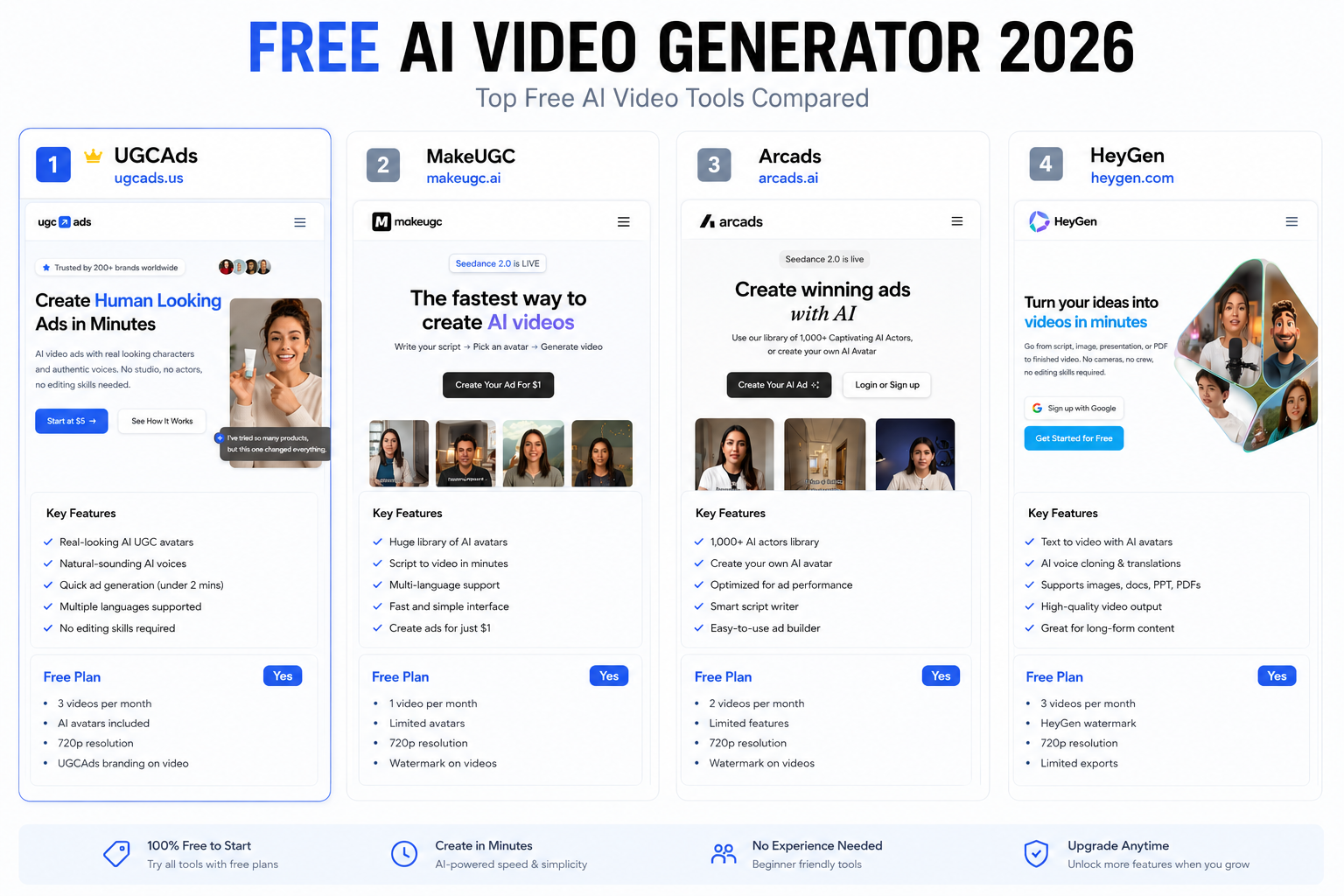
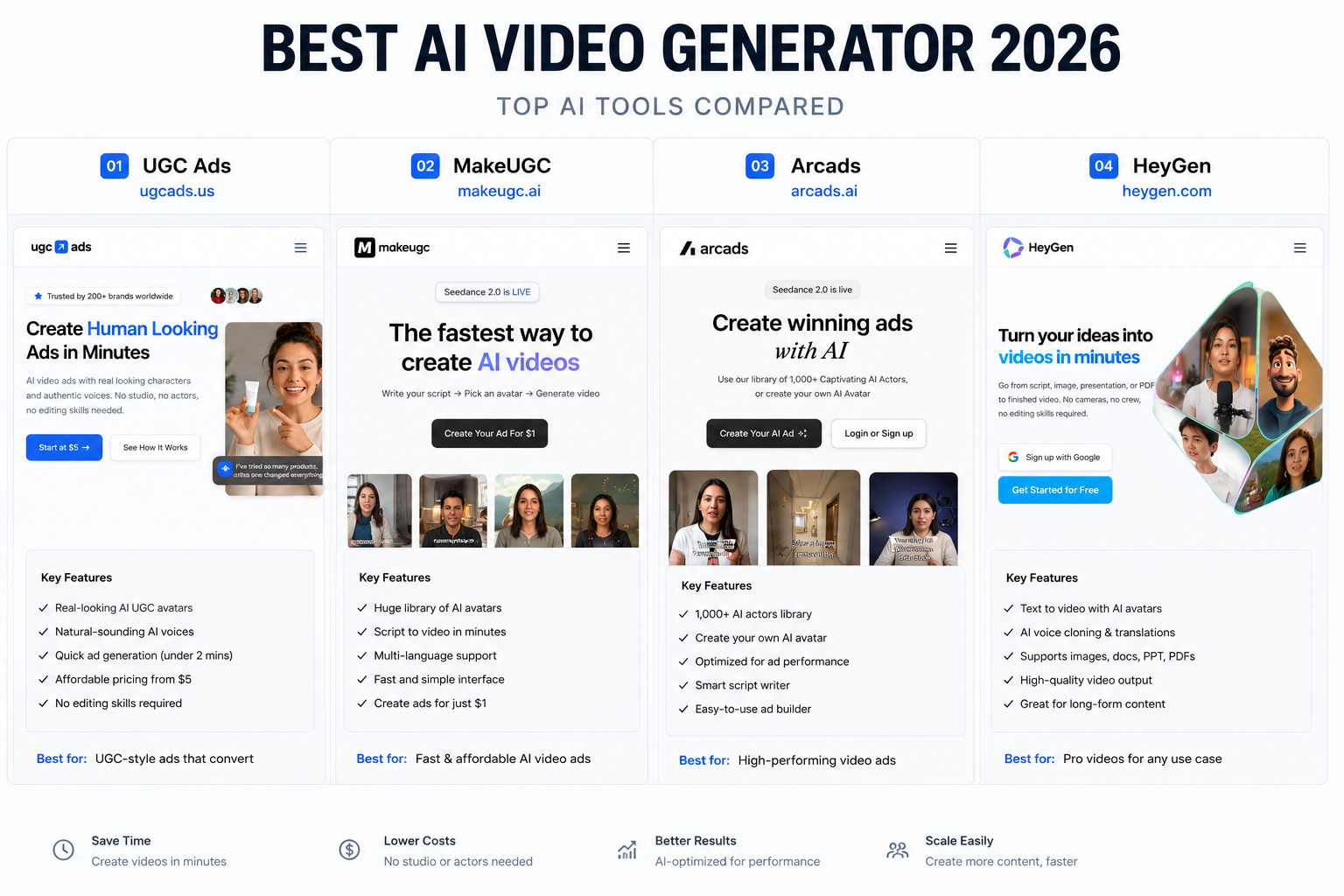
The term "AI video maker" covers a wide range of tools, from simple text-overlay video editors to full AI generation systems. For advertising specifically, what matters is the subset of tools that can generate a talking-head UGC-style ad — a realistic-seeming person delivering your script — without any human involvement.
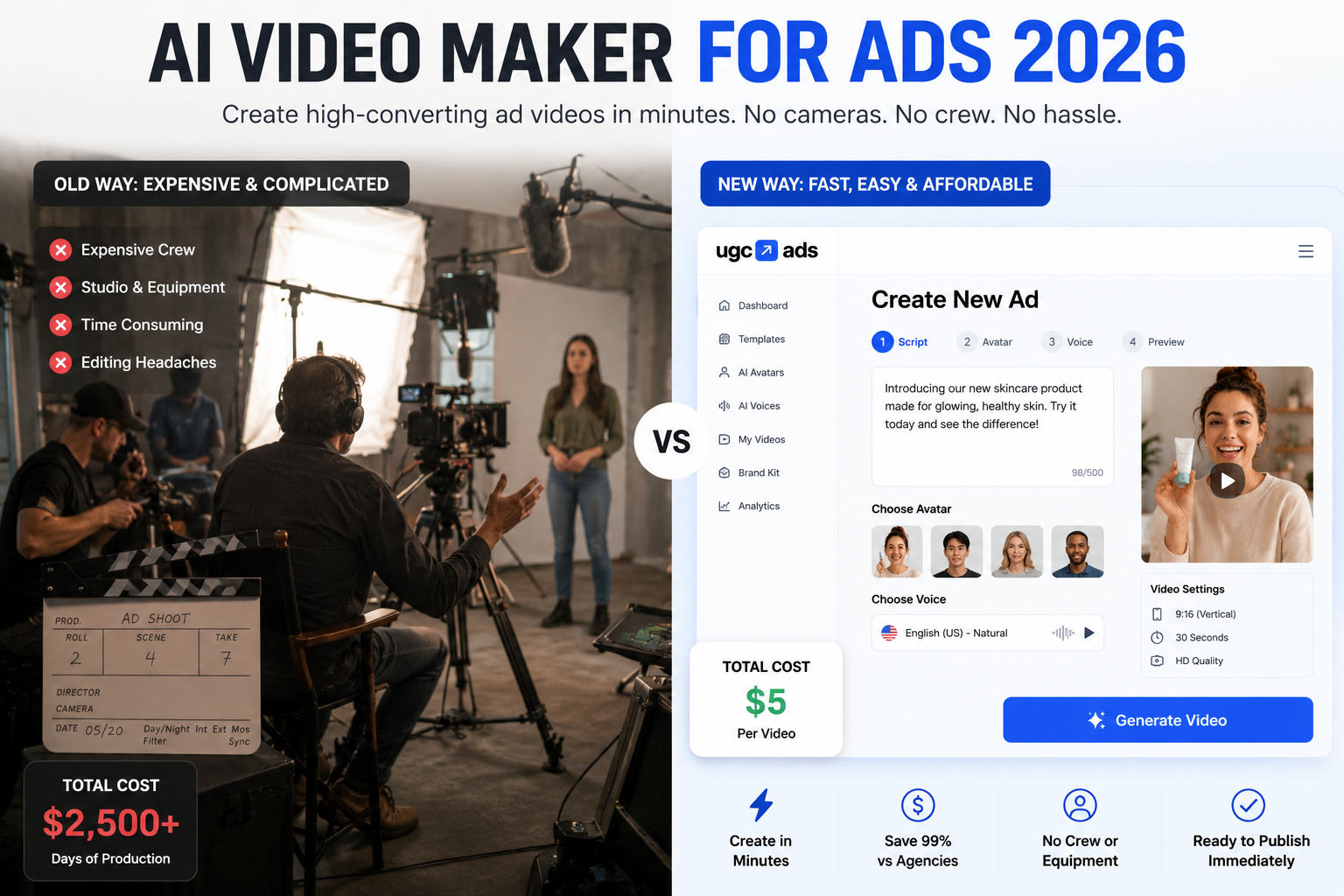
The production chain for a UGC video ad in traditional production involves: casting, scheduling, filming, voiceover recording, video editing, color grading, sound mixing, export, and delivery. Each step adds time and cost.
An AI video maker collapses this into: script input, avatar selection, generation, download. That is the entire process. The AI handles filming (generation), voiceover (text-to-speech), lip sync (audio-visual alignment), and export. You go from script to finished ad in under 2 minutes.
The Real Numbers: AI vs Traditional Production Cost
Let me give you accurate current market rates rather than inflated comparisons:
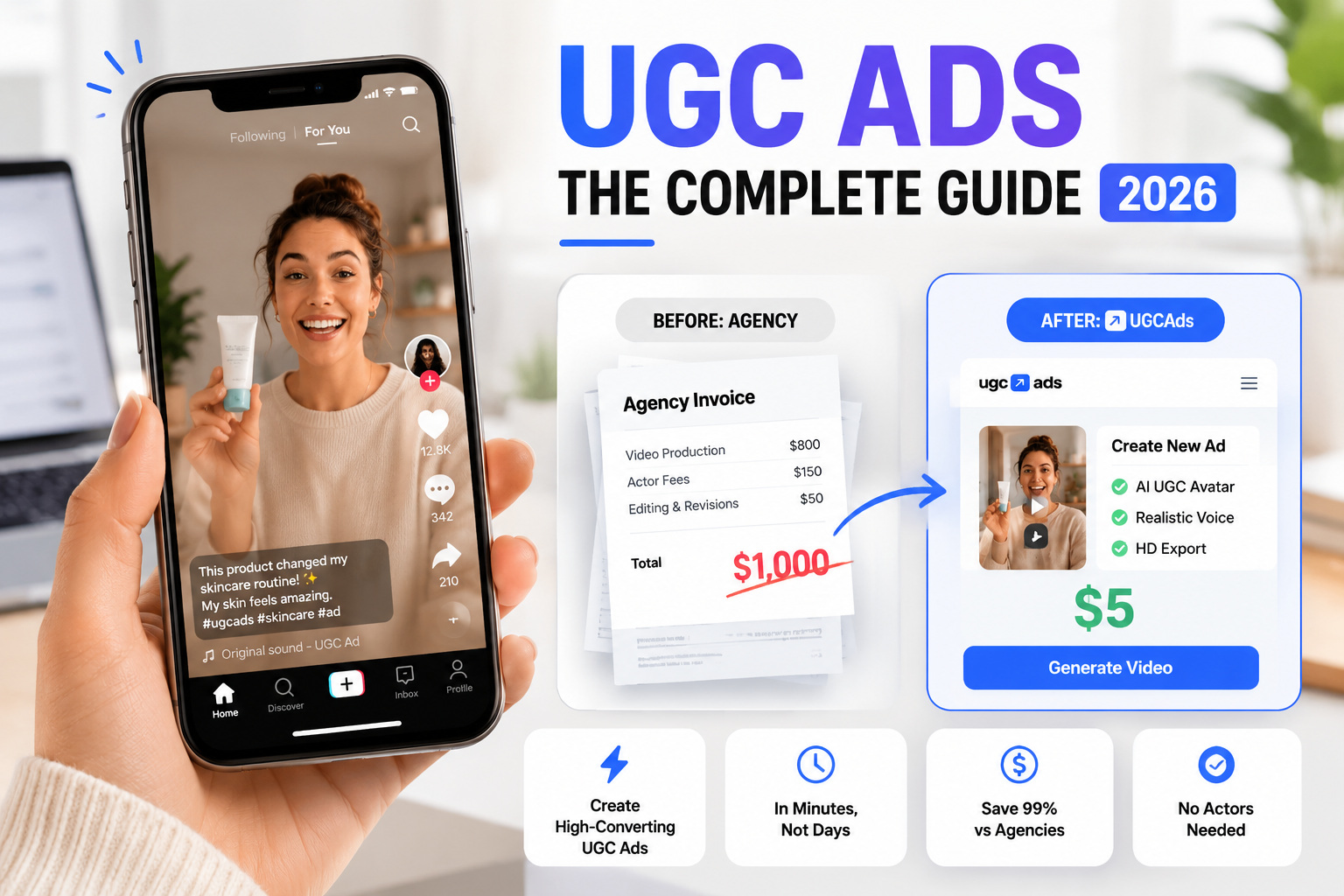
Freelance UGC creator via Billo or Insense: $50-$150 per video for entry-level creators, $200-$500 for mid-tier creators with better equipment and delivery quality. Turnaround: 7-14 days including brief, filming, and revision.
Video production company: $300-$800 per finished ad at the boutique level, $1,000-$3,000 at the full-service level. Turnaround: 2-4 weeks for a single deliverable.
AI video maker (UGCAds): Using the Creator plan at $79/month and 300 credits, each UGC video generation costs approximately 15 credits. That is 20 video ads per month for $79, or roughly $4 per video. Turnaround: under 2 minutes per generation.
The cost per video comparison is stark: $50-$500 for human production versus $4-$10 for AI production. But the more important number is the cost of running a complete creative test.
Testing 10 creative variations with human UGC creators: $500-$1,500 and 2-4 weeks. Testing 10 creative variations with an AI video maker: $40-$100 and an afternoon. The AI advantage compounds as you scale the testing cadence.
Is the Output Quality Actually Good Enough for Ads?
I want to answer this honestly because I have seen the AI video space oversell itself on quality claims.
The straightforward answer for 2026: yes, the best AI video makers produce output that is good enough for paid social advertising. Not good enough for broadcast television, not good enough for cinema-quality brand films, but good enough for the UGC-style content that dominates TikTok, Instagram Reels, and Facebook feeds.
The evidence is in the performance data. In split tests I have run and seen documented by other performance marketers, AI-generated UGC ads typically perform within 10-20% of human-created UGC on click-through rate and conversion metrics. The human UGC often has a slight edge on engagement and shares — people are more likely to comment on authentic-seeming human content. But the AI-generated content is close enough that the cost differential makes AI the better business decision for testing and volume production.
There is a useful principle from the TikTok for Business creative research that "native-looking content outperforms high-production content" for performance ads. This actually works in AI UGC's favor — the slightly imperfect quality of AI generation looks more native than polished agency production, and native-looking content is exactly what performs on TikTok and Instagram.
What the AI Video Makers Are Actually Good At
The formats and use cases where AI video makers perform best for advertising:
Talking-head testimonials. Single person, direct to camera, scripted message. This is the sweet spot for AI video generation. The avatar quality, lip sync, and delivery naturalness are all optimized for this format.
Product benefit callouts. Short, punchy videos calling out one specific feature or benefit with a visual demonstration. Fast to produce, easy to test multiple angles.
Before/after narrative. The AI avatar describes a before state (the problem) and after state (post-product). Works well for skincare, fitness, home improvement, and financial products.
Hook testing. The fastest ROI from AI video makers is systematic hook testing — generating the same ad body with five different opening hooks and testing which one resonates with your audience. This used to cost $500-$1,000 and two weeks. Now it costs $20-$50 and a few hours.
Where Traditional Production Still Has an Edge
Being honest about this matters. There are formats and contexts where traditional production is still the right choice:
Long-form narrative content. AI video models currently generate clips up to 15-20 seconds. Longer storytelling formats — 60-second brand stories, product demonstrations with complex narratives — require editing multiple clips together or using traditional production. The editing of AI clips is getting better but long-form is still harder.
Premium brand positioning. If your brand positioning depends on production value being a signal of quality (luxury fashion, premium beauty, fine jewelry), AI UGC may undermine that positioning. The "authentic and raw" aesthetic that AI production excels at is the opposite of what luxury brands need.
Real product integration. Showing a specific physical product in a realistic setting — someone holding your product, using it, placing it on a shelf — is still better done with real photography or video. AI product placement has improved but is not yet seamless for highly specific physical products.
Celebrity and influencer content. Real people with real audiences and real credibility cannot be replicated by AI avatars. If the reach and trust of a specific person is what you are buying, that remains a human asset.
A Real Example: 10 Creative Variations in One Afternoon
Here is a specific example of how we used an AI video maker for a testing sprint:
A supplement brand wanted to test different hooks for a protein powder ad. Their previous agency would have given them 2 options in 3 weeks for $600.
We generated 10 variations in one afternoon:
- 3 hooks focusing on the problem (low energy, slow recovery)
- 3 hooks focusing on proof (customer results, before/after)
- 2 hooks using price comparison ($3 per serving vs $8 competitor)
- 2 hooks using curiosity gaps ("Most protein supplements are missing this ingredient")
Total generation time: roughly 90 minutes including script writing. Total cost: $60 using a Creator plan. Each ad ran at $15/day for 5 days. The price-comparison hooks outperformed all others by 2.8x on CTR. The winning hook got scaled to $150/day and ran for six weeks.
Total cost to find that winner: $60 production + $750 test spend = $810. With traditional production, finding the same winner would have cost $600 production + $750 test spend = $1,350 and taken 3-4 weeks longer. The AI version was both cheaper and faster — the winning hook was running within 10 days of deciding to run the test.
How to Choose the Right AI Video Maker for Advertising
Not all AI video makers are built for advertising. When evaluating options, I look for:
Avatar quality and diversity. The avatar library needs to include enough demographic diversity that you can match your target customer demographic. A 25-year-old female avatar performing better for a skincare brand than a 55-year-old male avatar is obvious — but the tool needs to give you the right selection.
Lip sync accuracy. This is non-negotiable. Off-sync lip movement destroys the credibility of a talking-head ad. Test it yourself before committing to any platform.
Commercial usage rights. Verify explicitly that you can run AI-generated content as paid advertising on all platforms. Most paid plans include this. Some free tiers do not. Read the ToS.
Generation speed. For creative testing at volume, waiting 15-20 minutes per generation kills your iteration speed. The best platforms in 2026 deliver in under 2 minutes for standard UGC formats.
Multiple models. Different AI video models have different strengths. Having access to Seedance 2 for speed, Kling 3.0 for product interaction quality, and Sora 2 for cinematic quality — within one platform — gives you flexibility to match the model to the format. UGCAds is currently the only platform that packages all four leading models in one ad-focused workflow.
Making the Switch from Traditional to AI Video Production
The practical transition looks like this:
- Start with a parallel test. For your next product, produce two ads with traditional production and two with AI generation using the same scripts. Run them against each other. Let the performance data tell you whether AI output meets your quality bar for your specific brand and audience.
- Build a script library. The AI video production workflow rewards brands that develop reusable script templates. Invest time in developing 3-5 proven script structures for your brand and product category.
- Use AI for testing, humans for scaling. A practical hybrid approach: use AI video makers for your creative testing (5-10 variations per test, high iteration speed) and bring in human creators for ads you know you want to scale aggressively with significant spend behind them.
The UGCAds Creator plan at $79/month is the starting point I recommend for brands that want to run a real creative testing operation. 300 credits covers roughly 20 video ads per month — enough for a weekly testing cycle with room to generate product photography and try-on content alongside the video work.
Also worth reading: our direct comparison of AI video creators vs traditional agencies if you want a deeper look at the cost and speed breakdown by production format.