Why UGC Ads Dominate Performance Advertising in 2026
I have been watching ad creatives for a long time. The shift toward UGC-style content was already visible in 2021, but by 2024 it had become so dominant on TikTok and Meta that brands running polished agency-produced video were actually at a disadvantage. Not because polished video is bad — it can be great — but because on platforms designed to surface authentic content, ads that look authentic get better placement and lower CPMs.
A Nosto study found that consumers are 2.4 times more likely to say UGC is authentic compared to brand-created content. A separate analysis from Nielsen showed that 92% of consumers trust peer recommendations over advertising. The data has been consistent for years: when the format of an ad aligns with the content people came to the platform to see, it performs better.
This guide is what I wish had existed when I was figuring this out. It covers what UGC ads are, why they work, how to produce them at scale, and how the AI UGC generator landscape has changed the production economics completely.
What Are UGC Ads, Exactly?
UGC ads are video or image advertisements that are designed to look like they were created by a real person — a customer, a fan, an everyday user — rather than a marketing department.
The key word is "look like." The content might actually be brand-produced (and increasingly, AI-produced), but the format, framing, and delivery mimic organic user content. Casual camera angles. Relatable language. Direct address to the viewer. No branded lower-thirds or stock music.
This is different from actually using real customer-generated content, which is a separate (and also valuable) strategy. Paid UGC ads are professionally scripted and produced content in the style of organic UGC. When done well, the viewer can not tell the difference.
Why Do UGC Ads Work Better Than Traditional Ad Creative?
Several things are happening simultaneously when a UGC-style ad outperforms a polished brand ad:
Feed compatibility. On TikTok and Instagram Reels, the algorithm serves a mix of organic posts and paid ads in the same feed. Ads that look like organic content get watched longer because the viewer does not immediately identify them as ads. Watch time is a primary signal in both TikTok's and Meta's ad ranking systems. Higher watch time means better placement and lower cost per result.
Credibility transfer. When a real-seeming person recommends a product on camera, some of the credibility of a peer recommendation transfers even when viewers know it is technically an ad. This is the same mechanism that makes influencer marketing work, applied at a format level.
Relatability over aspiration. Polished brand advertising is aspirational — it shows an idealized version of what life could be like with the product. UGC is relatable — it shows a recognizable version of life with the product integrated. For most e-commerce categories, relatable outperforms aspirational on direct-response metrics.
TikTok's internal research has documented that ads filmed in a native style (vertical, casual, authentic-seeming) generate significantly higher completion rates and click-throughs compared to repurposed TV-style ads. The format advantage compounds over time as platforms tune their algorithms toward rewarding native-style content.
What Are the Different Types of UGC Ads?
The "talking head to camera" format is what most people think of first, but UGC-style ads span several formats:
Talking-Head UGC
The most common and highest-converting format for most categories. A person faces the camera and delivers a scripted message that sounds like their genuine experience with the product. This is what AI UGC generators like UGCAds are specifically optimised to produce.
Works best for: most e-commerce categories, supplements, software, services, DTC brands.
Product Unboxing and Reveal
A person receives and opens a package, reacting to the contents. The reaction element is central — not just the unboxing mechanics but the genuine (or genuine-seeming) delight or surprise. Works well for subscription boxes, gifts, beauty sets.
Before and After
Split screen or sequential content showing a transformation attributable to the product. Extremely high performing for skincare, fitness, home improvement, and fashion. The AI try-on feature on UGCAds produces this format efficiently — before/after is one of the ad types that has translated well to AI production.
Tutorial and How-To
A step-by-step walkthrough of using the product. Particularly valuable for products with a learning curve or multiple use cases. Reduces purchase anxiety by answering "how do I actually use this?" before the customer asks.
Problem-Solution Story
The creator describes a relatable pain point, then introduces the product as the solution. This follows the classic direct-response structure but in a UGC wrapper. In my experience, this is the highest-converting script structure for cold traffic across most verticals.
How to Write a UGC Ad Script That Actually Converts
The script is the single most important variable in a UGC ad's performance. I have seen UGC ads with mediocre production outperform beautifully shot ads because the script was tighter.
The structure that works most consistently is what most copywriters call the HOOK-PROBLEM-SOLUTION-CTA framework:
- Hook (0-3 seconds): This determines whether your ad gets watched at all. It must stop the scroll in the first 1-2 seconds. The most effective hooks are specific ("I spent $400 on product photos before I found this"), provocative ("Stop making this mistake with your Facebook ads"), or pattern-interrupting ("The reason 90% of e-commerce ads fail"). Generic openers — "Hi, I wanted to talk to you about..." — are the fastest way to lose viewers before your ad has started.
- Problem (3-8 seconds): Name the pain point your audience has. Be specific enough that it feels personal. "You're spending $300 per video on UGC creators and waiting two weeks for delivery" works better than "creating video content is expensive and slow."
- Solution (8-20 seconds): Introduce the product. Show it working. Use specific claims where you have them ("from script to finished video in under 90 seconds," "product photos that look like a $2,000 studio shoot"). Specificity is credibility.
- CTA (final 3-5 seconds): One action. Not two. Not "follow us and click the link." "Click the link below and try it for $5." Simple and direct.
Total script length for a 20-30 second ad: aim for 75-100 words. Read it aloud and time it. If you are over 30 seconds with natural delivery, cut it down. Ads over 30 seconds have dramatically lower completion rates on TikTok.
How Much Does UGC Ad Production Cost in 2026?
This is where the market has genuinely changed over the past two years. Let me give you current numbers:
Human UGC creators:
- Billo or Insense marketplace creators: $50-$150 per video, 7-14 day delivery
- Mid-tier influencer/creator collaboration: $200-$500 per video
- Top-tier UGC creators with large audiences: $500-$2,000+
AI UGC generation:
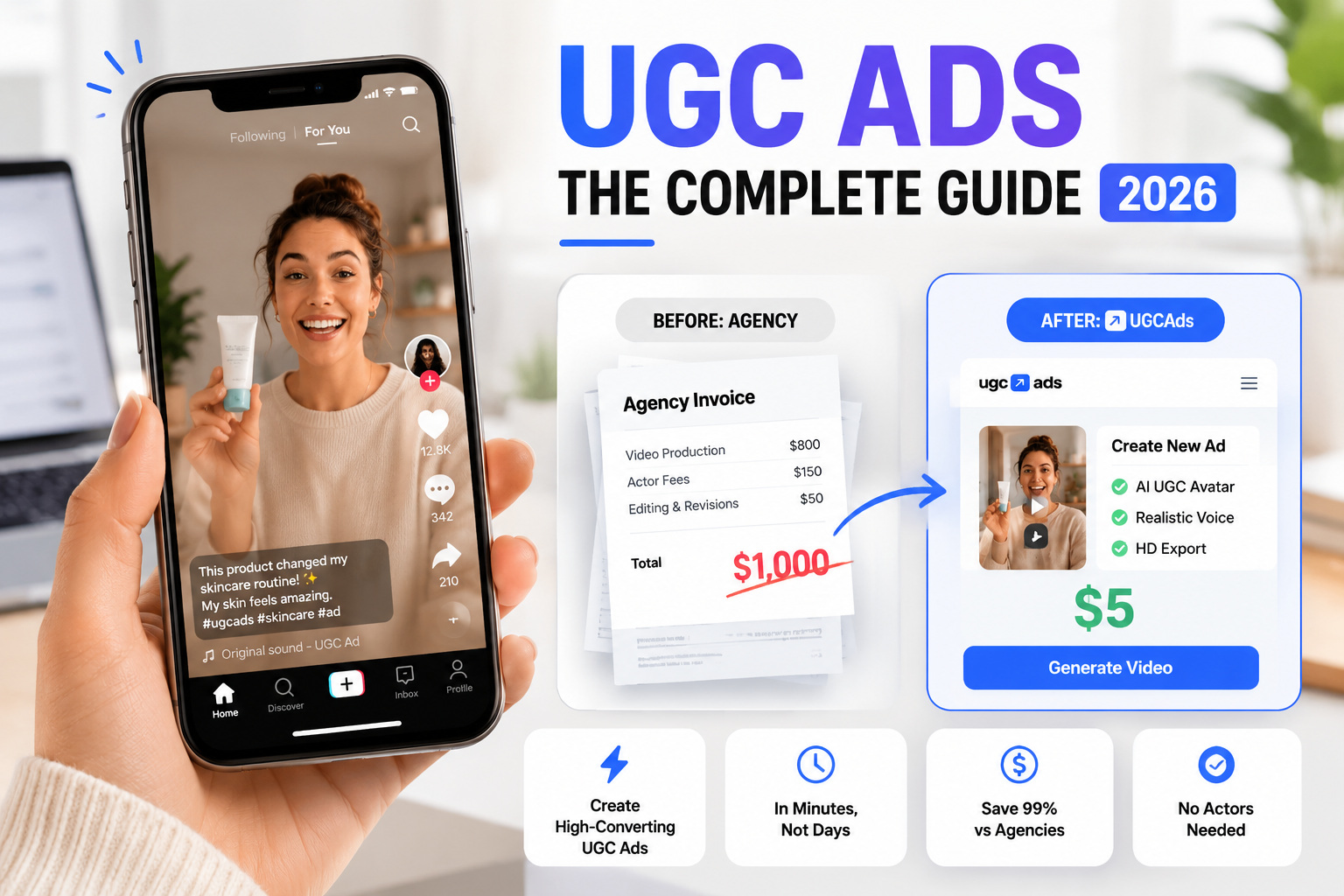
- UGCAds Starter (one-time): $5 for 1 video + 25 product photos + 8 try-on generations
- UGCAds Basic ($39/month): 100 credits, covering 6-7 video ads + product photography
- UGCAds Creator ($79/month): 300 credits, ~20 video ads or a mix of video + photos
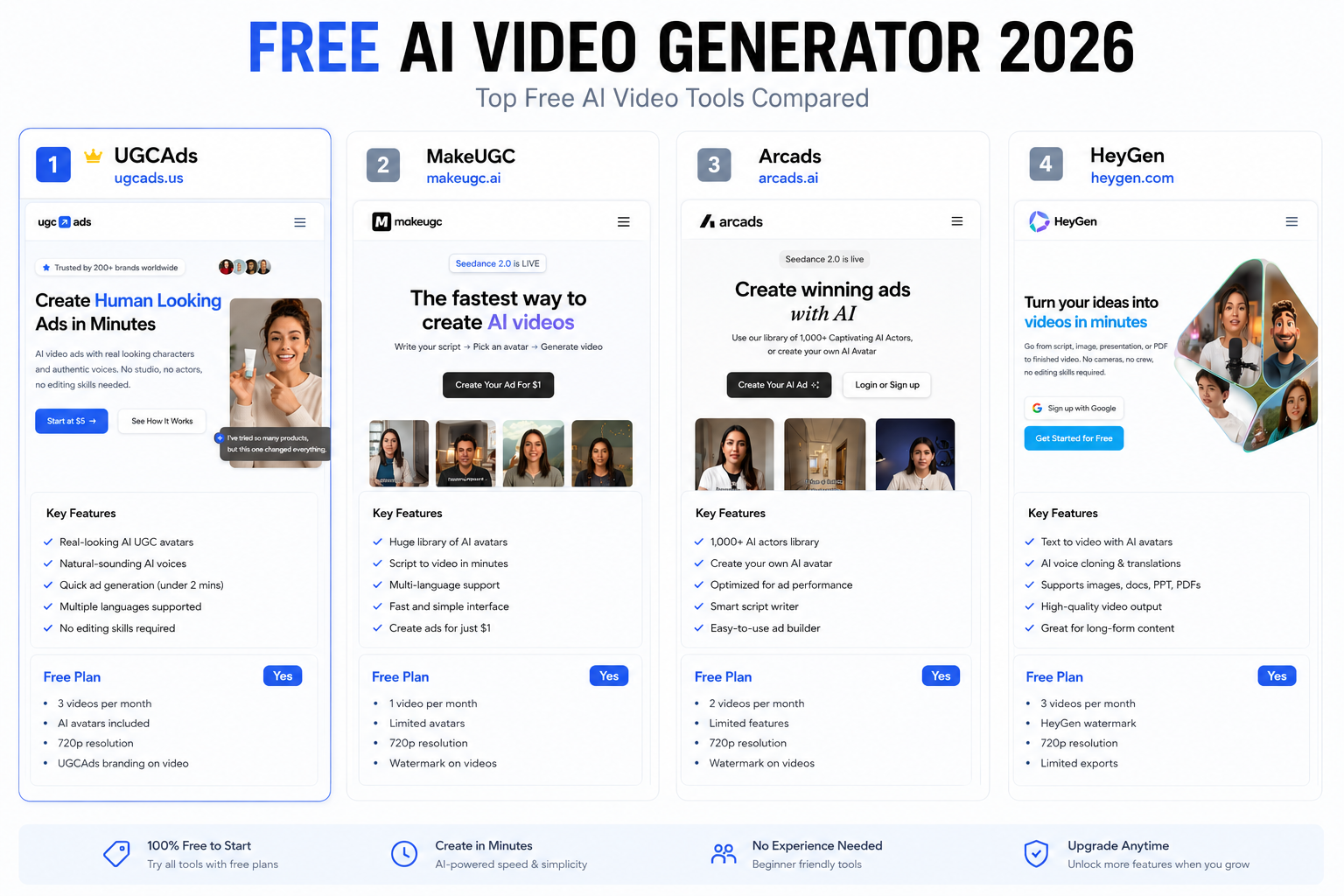
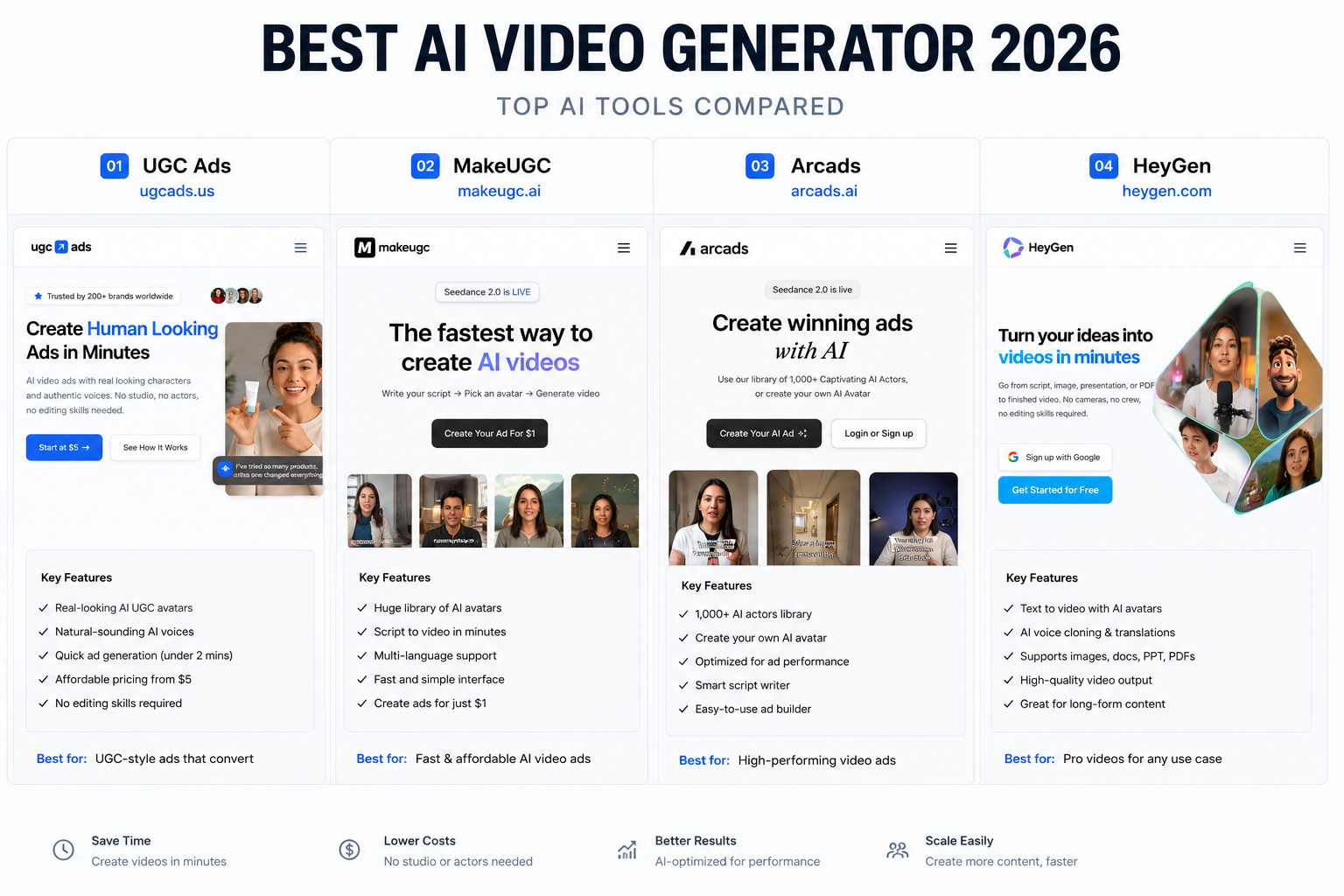
- HeyGen Creator: ~$50/month for comparable video volume
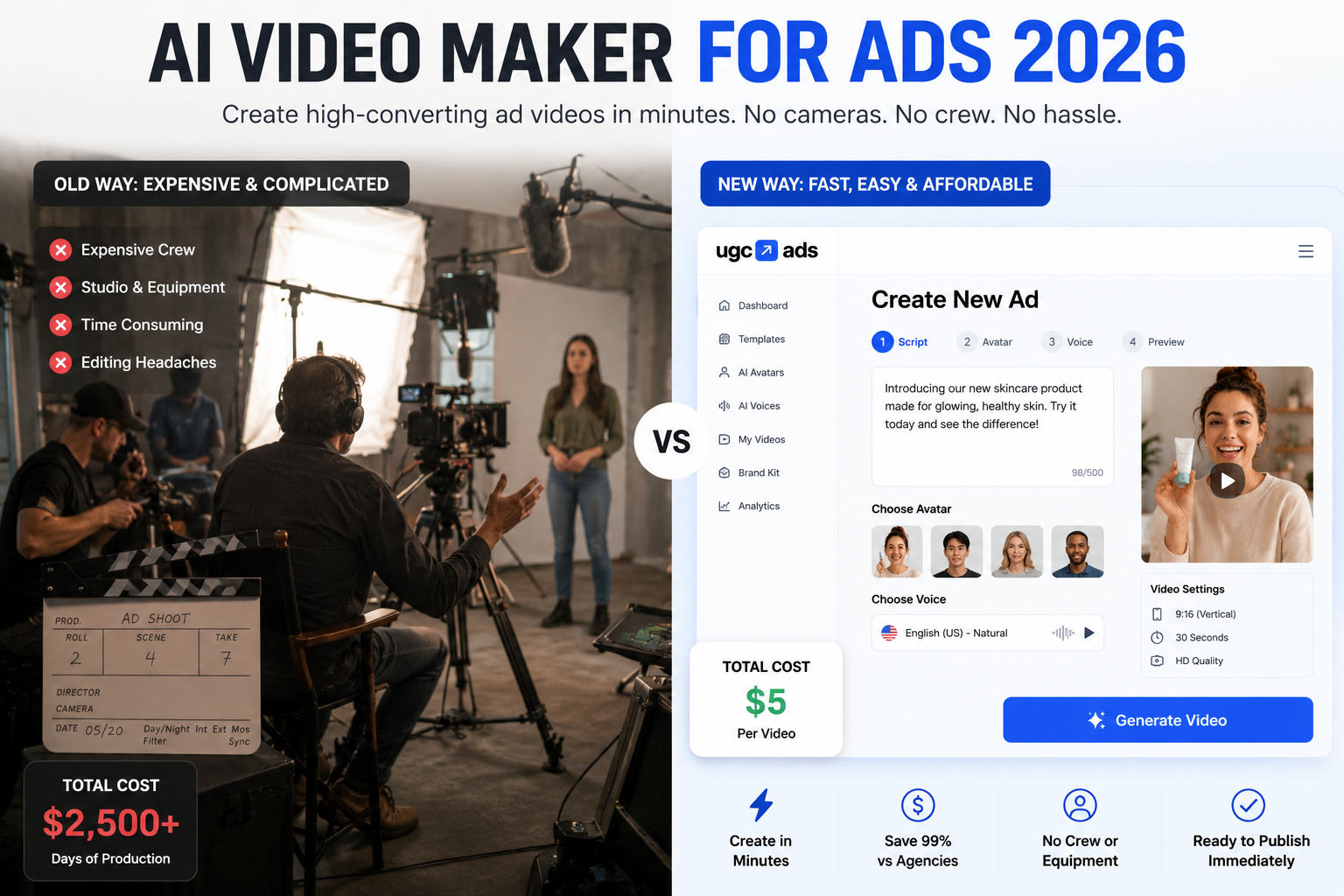
At production volumes above 5 videos per month, AI generation is 85-95% cheaper than human UGC creators. The quality gap has narrowed to the point where most brands running split tests find the AI-generated ads performing within 10-15% of human-created UGC on most metrics — and the cost difference more than compensates for that performance gap.
How to Test UGC Ads: The Creative Testing Framework That Works
The biggest mistake I see brands make with UGC advertising is treating a single ad like a bet. They produce one video, run it, and judge AI video (or UGC in general) based on whether that one piece of content performs.
The correct mental model is: creative is a variable you iterate toward a winner. Most ads do not work. A few ads work extremely well. Your job is to test fast and cheap to find the winners, then scale them.
Here is the testing framework I recommend:
- Week 1: Generate 5 ads with different hooks but the same product and CTA. Each tests a different entry point: problem-focused, price-focused, social-proof-focused, curiosity gap, identity-based.
- Week 1-2: Run each at $10-20/day in a CBO campaign. Give each ad 3-5 days to accumulate enough impressions to be statistically meaningful (at least 1,000 impressions, ideally 3,000+).
- End of week 2: Kill the bottom 3 by CTR and CPA. Keep the top 2. Generate 5 new variations of the winning hook angle — different avatars, slightly different script, different visual framing.
- Week 3+: Repeat. The winning hook from this round becomes the control. Challengers need to beat the control to stay in rotation.
With traditional UGC production, this framework is too expensive to execute — you are spending $500-$1,500 to generate 5 test ads, and you are waiting two weeks just to start the test. With AI UGC at $10-50 for 5 ads, the entire framework becomes practical for brands at any budget level.
UGC Ads on Different Platforms: What Changes?
The fundamental format works across platforms, but there are important differences in what performs best on each:
TikTok
TikTok rewards high energy, fast cuts, and hooks that create immediate curiosity. The algorithm is extremely good at distributing content that generates high completion rates — so your hook quality determines whether the rest of your ad gets seen. Vertical 9:16, under 20 seconds for best completion rates. Audio is on by default, so your script matters more here than on Meta.
Meta (Facebook and Instagram)
Meta supports a wider range of UGC formats. Square 1:1 often outperforms vertical in Facebook feed placements. Instagram Reels prefers 9:16 like TikTok. Longer testimonial-style ads (30-60 seconds) can outperform shorter ones in Facebook feed because the audience is less transient. Captions are essential — a significant portion of Meta traffic views ads with sound off.
YouTube Shorts
Similar dynamics to TikTok for Shorts. YouTube's intent-based targeting means you can layer keyword targeting on top of UGC-style creative for purchase-intent audiences that TikTok cannot identify as precisely.
Is AI UGC Good Enough for Real Advertising in 2026?
I get asked this directly so I will answer it directly: yes, with caveats.
For the use case this article is about — direct-response video ads on TikTok and Meta — AI UGC generated by the top platforms is good enough for most brands. The output quality has crossed the threshold where the limiting factor is script quality and targeting, not visual production quality.
The caveats: for luxury brands where production value is part of the brand signal, AI UGC may not be the right primary format. For brands in heavily regulated industries (pharmaceuticals, financial advice), the claims in any UGC ad — AI or human — need careful legal review.
For the 90% of e-commerce brands that are not luxury and not heavily regulated, AI UGC is ready. The cost and speed advantages are so significant that the question is not "is AI UGC good enough?" but "how do we build a testing system around it?"
Getting Started: Your First AI UGC Ad
If you want to run your first AI UGC ad without committing to a subscription:
- Write a 20-30 second script using the hook-problem-solution-CTA structure. Time it aloud.
- Sign up at ugcads.us and try the $5 Starter pack.
- Pick an AI avatar that matches your target customer demographic.
- Choose Seedance 2 for your first generation — it is the fastest model and produces strong results for standard UGC formats.
- Generate, review (lip sync and background consistency), download.
- Upload to TikTok Ads Manager or Meta Ads Manager. Set a $20/day budget. Run for 5 days.
- Evaluate performance. If CTR is above 1% on TikTok or 2%+ on Meta, you have a working creative worth scaling.
Total investment: $5 plus ad spend. Total time from signup to live ad: under 20 minutes your first time.
The brands that are winning with AI UGC right now are not doing anything technically sophisticated. They are using a simple script framework, testing fast, and doubling down on what works. The AI production layer just makes the testing affordable enough that almost any brand can run this system.