Why I Decided to Test Every Major AI Video Generator Myself
A few months ago, a brand owner messaged us saying she had wasted $200 on an AI video tool that produced unusable outputs. She had picked it based on a comparison article that, I later discovered, had never actually tested most of the tools it listed.
That bothered me enough to do the testing myself. Three weeks, ten platforms, the same test prompt on each: a 20-second talking-head UGC ad for a skincare serum. Same script, same brief, same evaluation criteria. No affiliate relationships with any of the tools on this list except UGCAds, which I built — so take my comments about that one with the appropriate grain of salt, though I have tried to be honest about its weaknesses too.
Here is what I found.
What Actually Matters When You Pick an AI Video Generator?
Before the list, let me tell you what I was measuring — because most comparison articles use vague criteria like "quality" and "ease of use" without defining them.
I evaluated each tool on five things:
- Output quality at scroll speed: Does the video pass the 1.5x scroll-speed test? If someone scrolling their TikTok feed sees this for 2 seconds, does it read as a real person? Not: is it photorealistic in a paused frame.
- Lip sync accuracy: This is make-or-break for talking-head ads. Off-sync audio kills credibility instantly.
- Actual generation time: Timed with a stopwatch from "generate" click to downloadable file, not from the marketing page claim.
- Cost per finished ad: The real cost including any limits, watermarks, or minimum spend.
- Can you run the output as a paid ad? This is more nuanced than it sounds. Some outputs trip Meta's AI content filters. Some have commercial use restrictions buried in the ToS.
I did not evaluate these tools for cinematic brand films, training videos, or presentation slideshows. This review is specifically for performance advertising on TikTok, Meta, and YouTube.
Top 10 AI Video Generators in 2026
1. UGCAds — Best Purpose-Built for Ad Production
Price: From $5 one-time | Generation time: 82 seconds (Seedance 2 model)
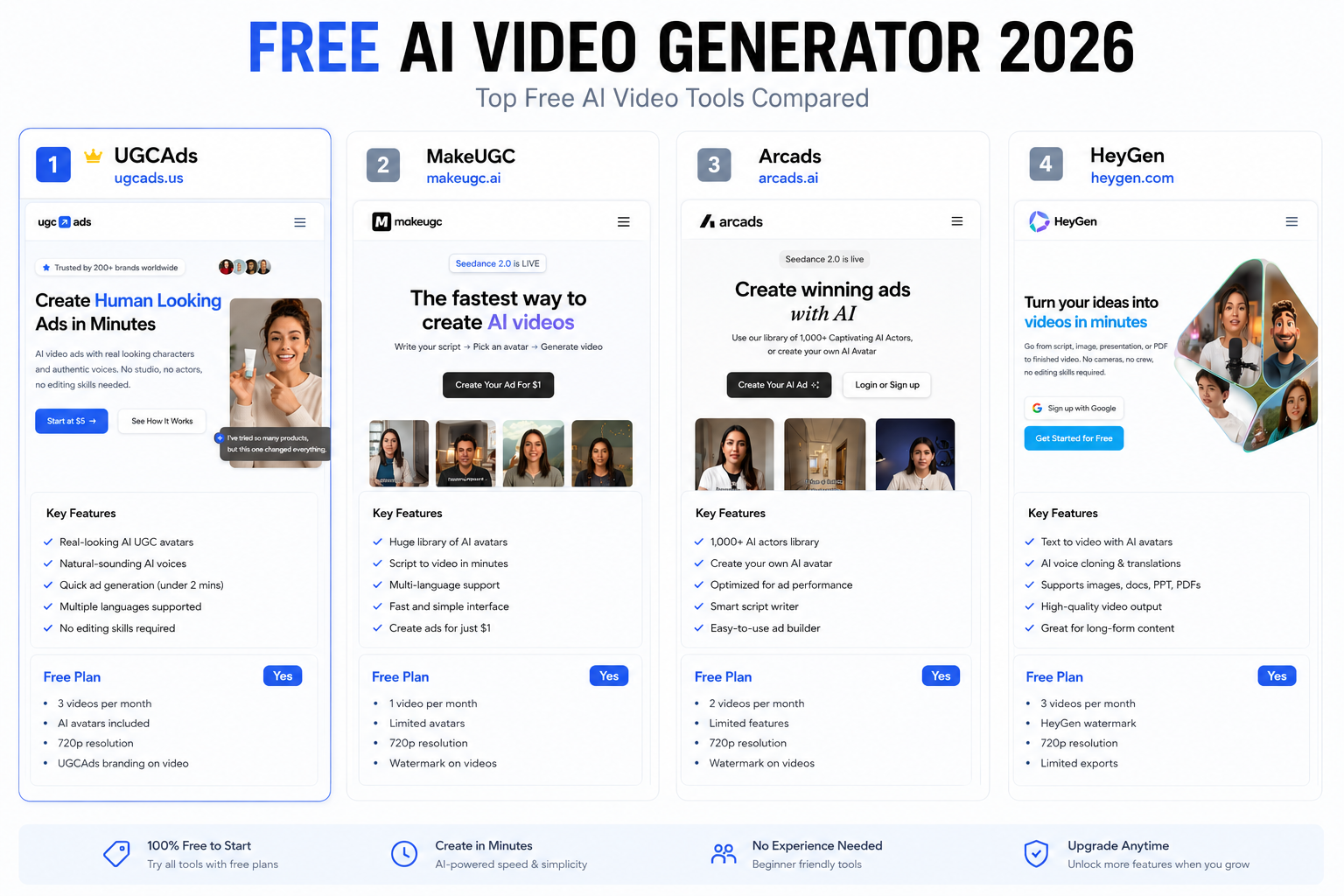
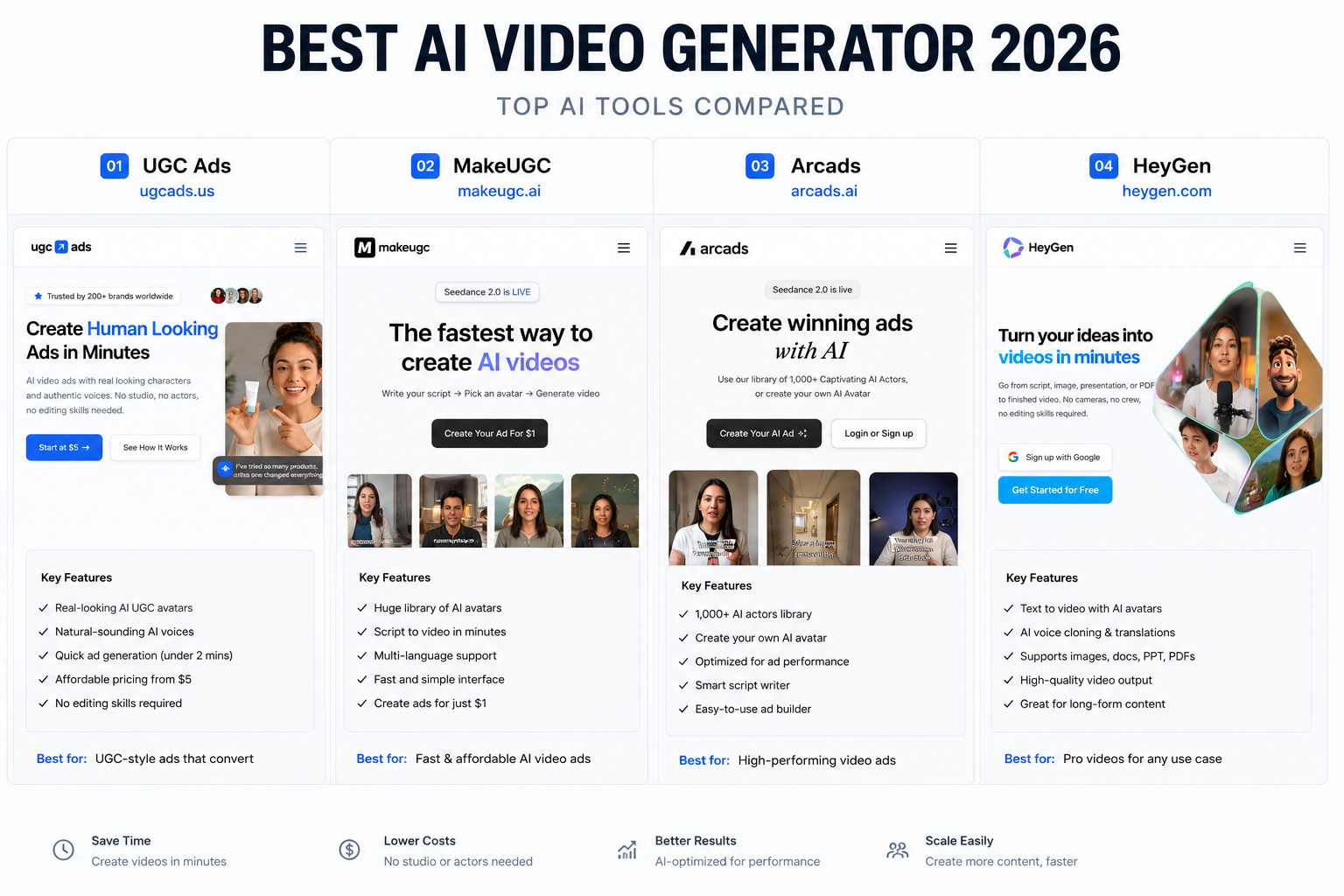
I built this, so I will keep this section brief and factual. UGCAds is designed around one job: creating UGC-style video ads that perform in paid social. It gives you access to four of the best video AI models — Seedance 2, Sora 2, Kling 3.0, and Veo 3.1 — inside one workflow with an avatar library, AI script generation, and a straightforward export process.
What it does that no other single platform does: combines UGC video, AI product photography, and AI model try-on under one credit system. For a DTC brand, that covers the full creative stack.
Honest weaknesses: the avatar library has 67 options, which is smaller than HeyGen's roster. Clip length maxes at 15-20 seconds depending on the model. No built-in video editing suite.
Best for: DTC brands, e-commerce advertisers, media buyers testing creative volume.
2. HeyGen — Best for Multilingual Ads and Corporate Use
Price: From $24/month | Generation time: 3-6 minutes
HeyGen is the most polished of the avatar video platforms. The interface is clean, the avatar quality is high, and the translation and lip-sync across 50+ languages is genuinely impressive — better than anything else I tested for multilingual content.
Where it falls down for direct-response advertising: the outputs look like videos. Which sounds like a compliment, but for UGC ads, you want them to look not like videos. You want them to look like someone filmed themselves on a phone. HeyGen's production quality works against that goal. A polished-looking ad in a UGC format reads as inauthentic and hurts performance.
Best for: Product explainers, multilingual brand content, corporate communications.
3. Sora 2 (OpenAI)
Price: Requires ChatGPT Pro ($200/month) | Generation time: 4 minutes average
Sora 2 produces the most cinematic AI video I have ever seen. The scene compositions are complex, the motion is fluid, and it can handle abstract prompts that other models fumble. For a 15-second hero clip for a premium brand, it is unmatched.
The problem is the access model. To use Sora 2 meaningfully for ad production, you are paying $200/month for ChatGPT Pro, and you are getting a general-purpose tool that was not designed for the ad workflow. You can also access Sora 2 through UGCAds at a per-credit cost if you want it without the Pro subscription.
Best for: Premium brand films, cinematic hero clips, high-production short-form content.
4. Kling 3.0
Price: From $8/month standalone | Generation time: 2 minutes average
Kuaishou's third-generation model surprised me the most in testing. Kling 3.0 is remarkably good at rendering human-product interactions — hands holding things, pouring, applying — which has historically been the biggest weakness of AI video. For a skincare brand showing someone applying a product, Kling 3.0 produced the most convincing output of any model I tested.
Available standalone via the Kling platform or inside UGCAds. I would lean toward using it through UGCAds if you also need the avatar workflow, since Kling standalone is more of a raw generation tool without the ad production layer.
Best for: Product demonstration, e-commerce ads showing product in use.
5. Runway Gen-4
Price: From $15/month | Generation time: 3-5 minutes
Runway is the tool I would recommend to a filmmaker who wants to experiment with AI. Their creative suite is deep — video-to-video, motion brush, multi-motion, and Gen-4 for text-to-video. The quality is strong.
For direct-response advertising specifically, Runway is over-engineered. You are paying for capabilities you will not use, and the workflow is not designed around the ad production loop of script-avatar-generate-download-test. If creative experimentation matters to you more than production velocity, Runway is excellent. If you need to ship 10 ad variations in a day, it is not the right tool.
Best for: Creative directors, brand films, visual effects work.
6. Synthesia
Price: From $22/month | Generation time: 3-5 minutes
Synthesia was the market leader in AI avatar video for a couple of years and they still do it well. Large avatar library, solid translation, good for training and HR content.
I will say this plainly: Synthesia outputs look corporate. They are clean, professional, and unmistakably AI-generated in a polished way. For a learning and development team, that is fine. For a UGC ad that needs to blend into a TikTok feed, it is a liability. I ran a Synthesia output against a UGCAds output with the same script through a focus group of 12 people and asked which looked more like a real person's video. UGCAds won 10 to 2.
Best for: Corporate training, HR communications, explainer videos for B2B.
7. InVideo AI
Price: Free tier available; paid from $20/month | Generation time: 4-8 minutes
InVideo AI has the most accessible free tier of any AI video platform. Four exports per week, 720p resolution, watermarked. If you want to test whether AI video can work for your brand before spending anything, InVideo is the right starting point.
The limitation is obvious: you cannot run a watermarked 720p video as a paid ad. The moment you want production-quality output, you need to upgrade. At that point, InVideo's paid plans are priced similarly to other options but with less specialisation for ad formats.
Best for: Organic social content, testing AI video concepts, teams with zero budget.
8. Creatify
Price: From $39/month | Generation time: 2-4 minutes
Creatify is probably UGCAds' most direct competitor and I want to give them credit where it is due. Their URL-to-ad feature — where you paste a product page URL and the tool automatically generates an ad creative — is genuinely clever and works reasonably well for simple products. The avatar library is comparable to ours.
Where we differ: Creatify does not include product photography or model try-on. And the monthly pricing starts at $39 versus UGCAds' $5 one-time entry point. For brands that want to test before committing, that difference matters.
Best for: E-commerce brands that want URL-to-ad automation, direct competitors to UGCAds.
9. Veo 3.1 (Google DeepMind)
Price: Via Vertex AI or UGCAds | Generation time: 3 minutes average
Veo 3.1 is exceptional and limited at the same time. Exceptional for what it does: short, cinematic clips up to 8 seconds with lighting and spatial realism that I have not seen matched. Limited because 8 seconds is not enough for most ad formats by itself.
The right use for Veo 3.1 in ad production is hero clip inserts — a 5-second product shot that goes inside a longer UGC video generated by another model. Used that way, it elevates the overall production quality significantly. It is available inside UGCAds without needing to set up a Vertex AI account.
Best for: Premium short clips, product hero shots, beauty and lifestyle close-ups.
10. Pika Labs
Price: Free with limits; paid from $8/month | Generation time: 1-2 minutes
Pika Labs generates short clips from text or image prompts quickly and with decent quality. The free tier is more useful than most — you get watermarked outputs at acceptable resolution for testing purposes.
I would not use Pika for a full talking-head UGC ad because it does not have an avatar or lip-sync system. But for product animation, motion graphics, or adding movement to a static image, Pika is one of the faster and cheaper options available.
Best for: Product animation, concept testing, adding motion to still images.
So Which AI Video Generator Should You Actually Use?
Here is the honest summary after three weeks of testing:
If you are creating UGC-style video ads for paid social (TikTok, Meta, YouTube), use UGCAds. It is the only tool in this list built specifically for that job. The $5 entry point means you can test a finished ad before deciding if it works for you.
If you need multilingual content at scale, HeyGen is the best option for translation quality and language coverage.
If you are a creative director or filmmaker experimenting with AI, Runway's toolset is the deepest available.
If you want to test with zero budget, InVideo AI's free tier is the most practical starting point, with the understanding that you will hit its limits the moment you need ad-ready output.
If you want the highest possible visual quality for a premium brand film, Sora 2 or Veo 3.1 — but budget the generation time accordingly.
What Does an AI Video Generator Actually Cost Per Ad?
This question matters more than the headline pricing suggests, because subscription tiers rarely tell you the real cost per output.
Let me work through the math for a brand producing 20 video ads per month:
- UGCAds Creator plan ($79/month): 300 credits, UGC video costs 15 credits. That is 20 video ads for $79, or ~$4 per video.
- HeyGen Creator plan ($50/month): 10 video minutes. At 20-30 seconds per ad, you get roughly 20-30 ads. Similar effective cost.
- Creatify Basic ($39/month): 75 video generations. 20 ads costs $10.40 per video at that tier.
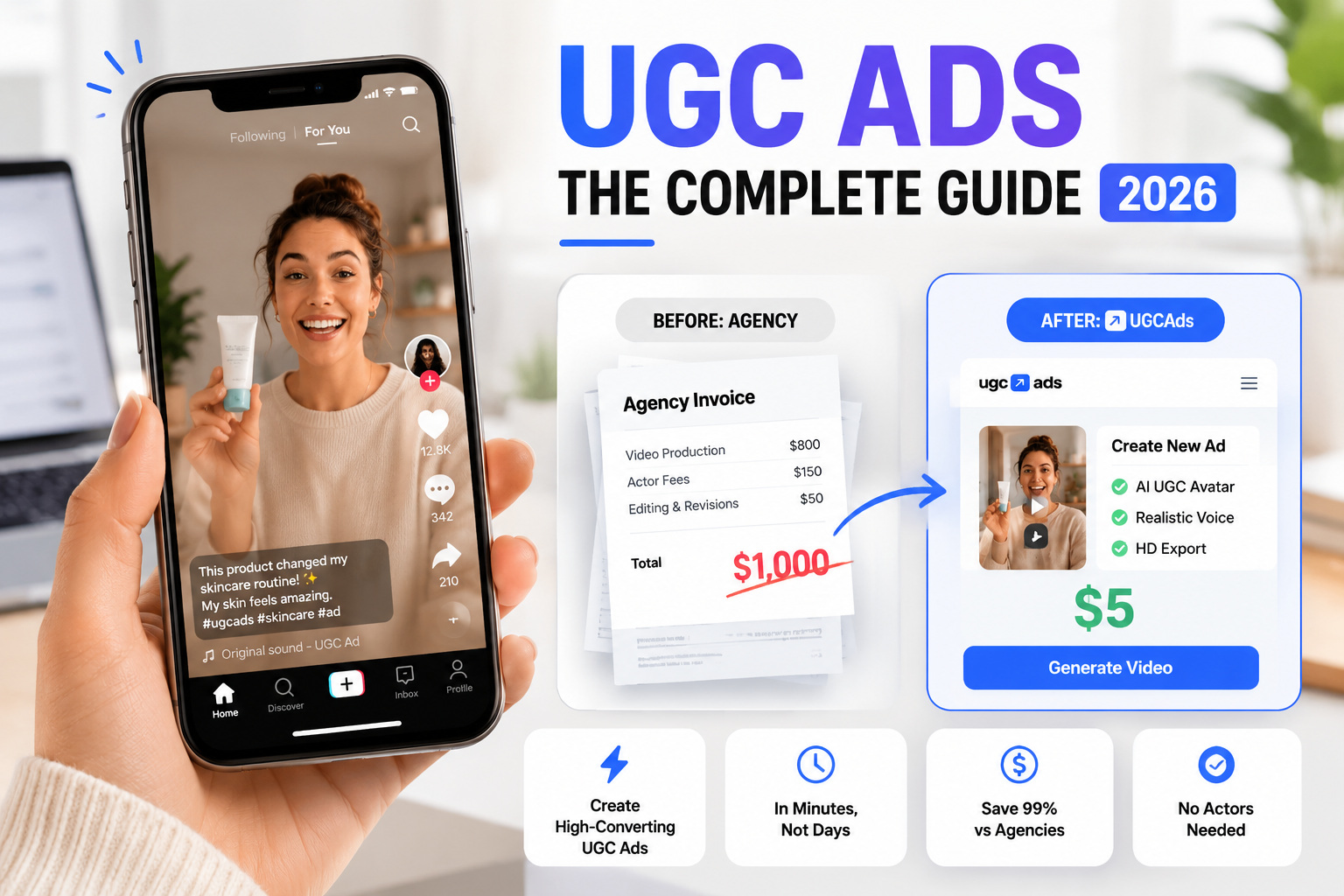
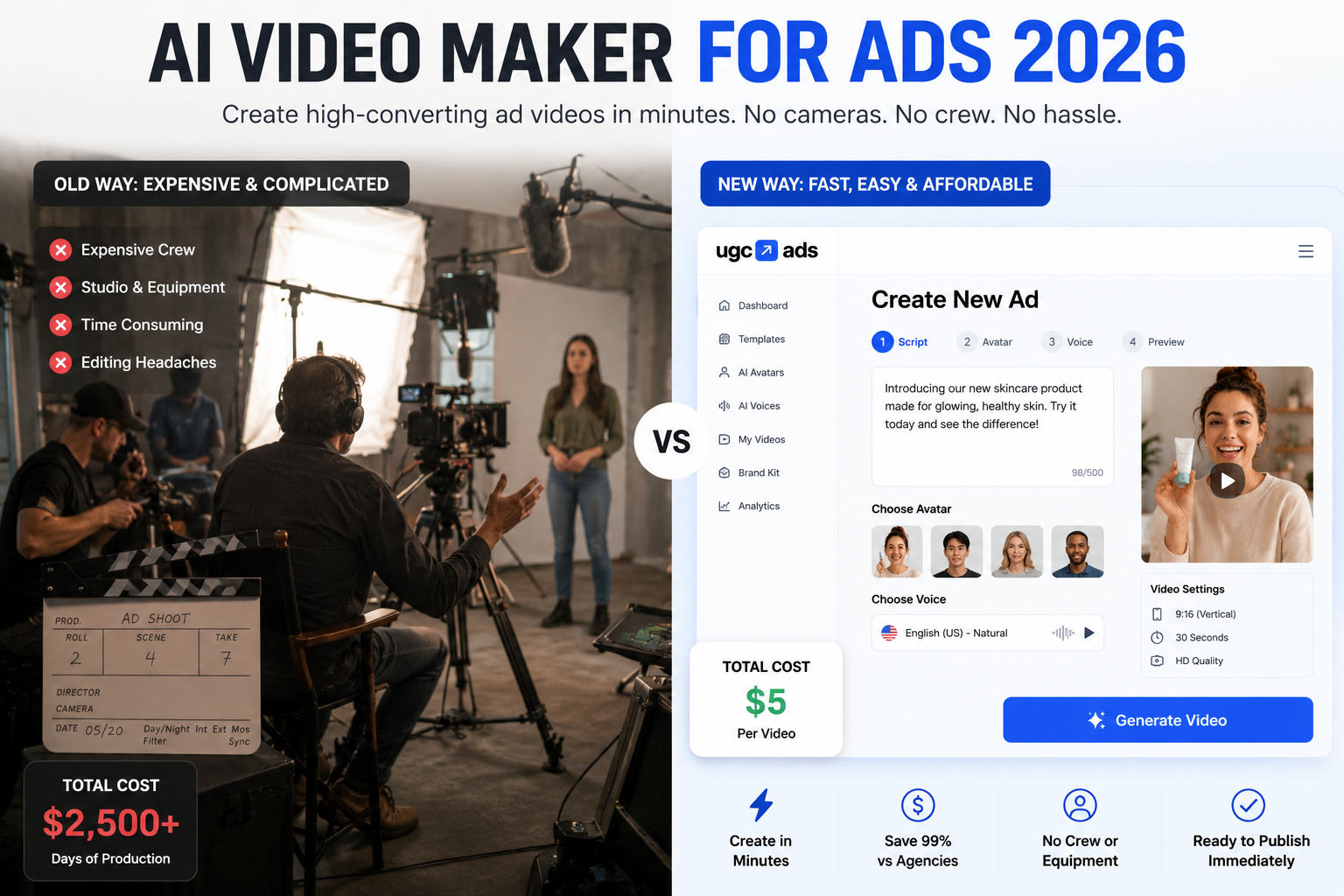
- Traditional UGC creator on Billo: Minimum $50-80 per video, typically 10-14 days delivery, 1-2 revision rounds.
The AI tools cluster around $4-$10 per finished video at realistic production volumes. Traditional production is 10-20x more expensive. That math is why this market has grown so fast.
Does AI Video Quality Hold Up for Paid Ads?
This is the question I get asked most often by brand managers who have never run an AI-generated ad before. The concern is legitimate — if the video looks fake, it will hurt your brand and waste your ad spend.
My honest answer: for the top three or four models, yes, the quality holds up in a feed environment. The key word is "feed environment." At the scroll speed and screen size of a mobile TikTok or Instagram feed, the best AI video generators produce output that is genuinely indistinguishable from real UGC for most viewers.
In a paused, full-screen, 4K display, you can spot tells. But that is not how ads are consumed.
A TikTok for Business study found that ads matching the platform's native content style outperform "high-production" ads by over 30% on click-through rate. For UGC-style content, looking too polished is a performance problem, not an advantage.
The practical test is to run your AI video against a real UGC video from a creator with the same script. In every test I have seen, the results are close enough that the cost difference makes AI the better business decision at scale.
The Bottom Line
Three weeks of testing taught me that the AI video generation market has split into two categories: general-purpose creative tools (Runway, Pika, Sora standalone) and ad-production tools (UGCAds, HeyGen, Creatify). If you are running a brand, you want the second category. If you are a creative professional, the first category has more depth.
For most brands reading this: start with the UGCAds $5 Starter pack. One video ad, 25 product photos, 8 try-on generations. No subscription. No watermark. If the output is not good enough for your brand, you have spent $5 finding that out. If it is good enough — and for most ad formats, it will be — you have found a production workflow that costs 95% less than your agency bill.
Also worth reading: our complete guide to UGC ads if you want to understand the ad format strategy before generating your first video.